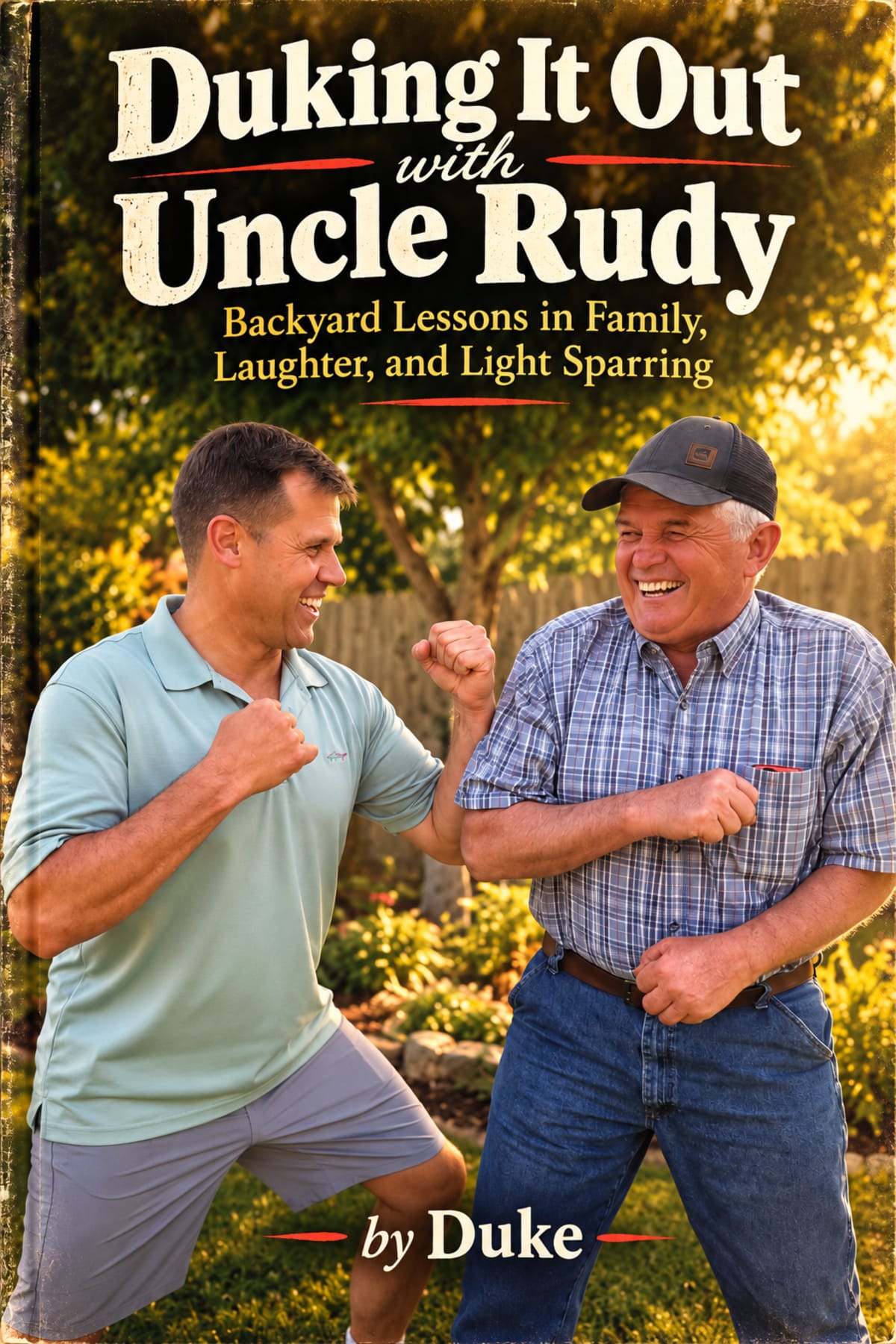
There are certain things you learn growing up on a Wisconsin dairy farm.
Cows don't care what time you went to bed. Tractors don't care how badly you need them to start. And when Uncle Rudy tells you to grab a wrench, there's a reasonably good chance you’ll hand him the wrong size. Even when it’s the size he asked for.
Nothing serious, mind you. Just enough to build character.
Or require stitches.
Uncle Rudy runs the family farm.
And by runs, I mean he operates it with the unquestioned authority of a five-star general, the financial oversight of a Depression-era banker, and the communication skills of a man who believes yelling instructions from a moving tractor is perfectly reasonable.
Uncle Rudy doesn't have employees.
He has relatives.
And relatives, as everyone knows, are considerably cheaper.
Growing up, I learned that the farm had a very simple organizational structure. Uncle Rudy was in charge. Everyone else was wrong.
No meetings. No performance evaluations. No opportunities for advancement. You could work there for thirty years and still be the idiot holding the flashlight.
And God help you if you pointed it in the wrong direction.
"Duke! Hold that damn thing where I can see!"
"I AM!"
"THEN WHY CAN'T I SEE?"
This was my introduction to leadership.
Years later, the United States Navy would spend considerable time and money teaching me the finer points of command, communication, and organizational effectiveness.
Uncle Rudy covered most of it in fifteen minutes behind the machine shed.
Usually with profanity and a wrench.
Occasionally both were airborne.
When I was a kid, I figured Uncle Rudy knew everything.
He could fix a tractor with three tools, a piece of baling wire, and language that seemed to fit the situation perfectly.
He could look at the sky and predict rain better than the television weatherman.
He could tell which cow was sick, which fence needed fixing, and which nephew was trying to disappear when the loaded hay wagon pulled into the driveway.
That last one was usually me.
The thing about farm work is that there's always something to do.
Finish milking? Clean the barn.
Finish cleaning the barn? Fix the fence.
Finish fixing the fence? Find the cow that got out.
Find the cow?
Congratulations. Something else broke while you were gone.
I once asked when we were going to be done.
He stared at me and laughed.
“Tomorrow. We’ll be done tomorrow.”
I carried that lesson with me for years.
Although a lunch break would’ve been nice.
Eventually, I left Wisconsin, went to college, joined the Navy, and became a Naval Aviator.
I flew military aircraft, traveled around the world, dealt with emergencies, and eventually commanded a squadron.
Thirty years in uniform. Thousands of hours in aviation. Leadership schools. Operational deployments. Command responsibility.
Quite an impressive résumé.
At least I thought so.
Then I went back to the farm.
"Hey, Rudy."
"Hey, Duke."
"How's everything going?"
"Good. Grab that shovel."
Just like that.
Thirty years of professional development.
Gone.
I was back at the bottom of the organizational chart.
No retirement ceremony. No gold watch. Not even a decent cup of coffee.
Just a shovel.
I once tried explaining to him that I'd been responsible for hundreds of sailors and aircraft worth millions of dollars.
He nodded thoughtfully.
Then pointed toward the barn.
"Well, you oughta be able to figure out that wheelbarrow."
Fair point.
People sometimes ask where I learned to keep going when things got difficult.
The foundation was poured long before I ever climbed into an airplane.
It was poured on a Wisconsin dairy farm.
In cold barns before sunrise, muddy fields, and broken machinery. Among stubborn animals and the simple understanding that complaining didn't make the work disappear—but it did make it more fun.
And in men like Uncle Rudy, who never needed a leadership seminar to understand responsibility.
You showed up.
You did the work.
You helped your family.
And when something broke, you figured out how to fix it.
Preferably before he found out you were the one who broke it.
The farm also taught me something else.
Don't take yourself too seriously.
No matter how many ribbons you wear, how many people you've led, or how impressive your accomplishments might seem, there's always somebody who remembers you as the kid who couldn't start the tractor.
And that person is probably Uncle Rudy.
After all these years, nothing much has changed.
I'm still Duke.
He's still Uncle Rudy.
And somewhere beneath the gray hair, multiple shoulder surgeries, and accumulated years, we're still standing in the same Wisconsin farmyard. The place where I learned that hard work matters, family matters more, and a good laugh can carry you through just about anything.
I may have gone off and seen the world.
Uncle Rudy stayed and kept the farm running.
Different paths. Different responsibilities.
But there's something reassuring about coming back to a place where nobody particularly cares what you've accomplished.
They just want to know whether you're going to help.
And whether you can still take a punch.
At least that's my version.
He will probably tell you something completely different. And knowing him, he'll add that I still owe him a week of work.
Which brings me to one final lesson from the farm.
You can retire from the Navy.
You can retire from just about anything.
But you can never retire from being Uncle Rudy's hired help.
Especially when he never hired you in the first place.
Keep on Keepin' On.
— Duke