The static returns—full and familiar—then something new cuts through, like the rattle of a tractor engine coughing to life.
I’m instantly taken back to my childhood on the farm, where wisdom smells like diesel fuel… and every lesson begins with a swear word.
[Announcer Voice: Young. Worn-in. Mildly impressed with himself.]
Howdy folks… You’ve stumbled onto Back Forty Talk Radio, 1070 AM—where the coffee tastes like motor oil, the air is crisp with a hint of manure, and the conversations are seasoned with sarcasm, stubborn pride, and a few choice words your grandma would’ve swatted you for.
You won’t find this stuff in textbooks—hell no. This is real talk. Real mistakes. Real damn funny. Learned the hard way.
So buckle up, buttercup. You’re about to learn The Art of Swearing—a farm kid’s field guide.
Fair warning: this memory comes with some colorful language—selectively censored for the faint of heart.
Now let’s get one thing straight.
I didn’t set out to become fluent in profanity. It’s not like I had flashcards or sat around conjugating swear words. There were no vocabulary tests and no “swear word of the day” calendars hanging in the kitchen—though that might’ve helped.
I learned the old-fashioned way—head down, ears open, getting a real-world education in swearing… and poor grammar.
Working around the farm, I shadowed Uncle Apple. His given name was David, but nobody called him that. Uncle Apple never held back, which made him the perfect teacher. He didn’t just sprinkle swear words into his speech—he constructed entire sentences out of them.
Me? I was just a kid—full of optimism, baby teeth, and bad ideas—tagging along in hand-me-down boots, clothes two sizes too big, and whatever barn coat and dirty trucker hat I could find.
Over time, through sheer repetition, swear words stopped being background noise and became part of the farm’s daily rhythm.
That’s when I grabbed my beat-up 1980s Trapper Keeper—tattered, torn, and covered in enough graffiti to make a middle schooler proud—flipped it open to a clean page and started taking notes.
Turns out there was a surprising amount of wisdom hiding beneath all that colorful language. Here are just a few of the lessons I picked up along the way.
ANIMAL INSTINCTS
Farm animals don’t respond to sweet talk. You can “here, kitty-kitty” or “come on, sweetheart” until you’re blue in the face, and they’ll just blink and stare at you with that dumbass look.
Years of completely unscientific farm research prove that if you want results, you lead with a good, hearty, profanity-laced greeting. A strong opener like, “Listen here, you son-of-a-bitch” lets the animals know this just got serious.
While Uncle Apple never formally explained how it worked, he taught me that every animal has a preferred curse.
Pigs perk up at the short, sharp ones. Quick little verbal stingers that cut through the air as fast as they root and grunt. A simple, “Come here, you f***er,” usually gets their attention.
Cows are slow to chew and slow to move. They respond best to something longer and more deliberate—profanity that builds and rumbles like distant thunder. “You stupid, ignorant, bull-headed cocksucker,” has just the right tone to encourage them into the stall for milking.
Mules are a category all their own. For reasons known only to mules, putting the word “dumb” in front of anything dramatically improves its effectiveness. “You dumb f***ing half-bred no-good-for-nothing…” is usually enough to get their attention—though it rarely improves their attitude.
GATE EXPECTATIONS
If you’ve never been around pigs, let me save you the trip—they f***ing stink, and they never shut the hell up.
It’s loud. It’s filthy. It smells like a thousand bad decisions fermenting in the summer sun.
And yet, there was no better place than the hog house for a kid accidentally majoring in creative profanity.
The only way to the hog house was over a gate and through a minefield of pig shit. Calling it a “gate” was generous. It was little more than a few flimsy old barn planks held together with rusted scrap wire. We never opened it—I’m sure it would’ve fallen apart if we tried—so we always climbed over it.
Uncle Apple started swearing before he even reached the gate. Nothing serious at first—just enough profanity to let the gate know he was coming.
He’d place one foot on it, check his balance, then commit and start climbing. The higher he went, the more the gate wobbled. By the time he neared the top, it was anybody’s guess whether the whole thing would hold together or dump him into the pig shit waiting patiently on the other side.
About halfway up, the casual swearing blossomed into a full-blown “cocksucker-cocksucker” symphony. Suddenly everything was a cocksucker—the gate, the farm, every tractor we owned, the pigs, the weather, and the poor bastard who thought building that gate was a good idea.
Most days he made it over, somewhat cleanly. But on days when he got hung up—Uncle Apple dangling from the top of that gate like a furious scarecrow, one leg over, one leg not—the real education began, unleashing words that do not exist in any known dictionary.
RISE AND SWEAR
The best part of waking up…
…is a few well-placed swear words in your cup.
Farm mornings are brutal, especially during a Wisconsin winter, when getting out of bed before sunrise feels like a direct assault on your soul. But the chores don’t care how you feel. So you cope. And the most effective coping mechanism is swearing.
It starts the moment your feet hit the floor. Before coffee. Before conversation. Before consciousness.
Think of it as a pre-cup of profanity—just enough to kickstart the system. A low, half-mumbled “this is some bullshit,” and you’re up and at it.
Getting dressed is a layering process: underwear, long underwear, multiple pairs of socks, heavy jeans, and flannel shirts. Every layer adds a little more effort—and a little less enthusiasm.
By the time you wrestle into the heavy barn coat and those rubber boots that go over the regular boots you just fought to put on—you’re fully committed to “f*** this nonsense.”
Finally ready to go and already sweating under fifty pounds of clothing, you stand there waiting on Uncle Apple, who is still wrestling himself into the rest of his gear—flopping around like a fish out of water trying to get his boots on, cussing every layer like it was personally responsible for the cold.
Then comes the moment of truth.
Hand on the doorknob.
Pause.
Deep breath.
You step outside—nostrils freezing together, lungs burning, air biting—and you let it rip.
One long, uninterrupted masterpiece that sounds like supercalifragilisticexpialidocious, but really comes out goddamnmotherf***ingcocksuckingwintertimeclusterf***!
Now you’re awake.
Ready for the day.
THE PERCUSSION SECTION
When farm equipment breaks, it’s always at the most inconvenient time—and any sense of calm evaporates instantly.
At first, it’s mild. Your basic “This piece of shit John Deere.” Almost respectful—as if you’re disappointed with your beloved green hay baler and don’t want to hurt her feelings just yet.
Then you find the problem and realize it’s not a quick fix.
The pacing begins. Eyes narrow. Jaw tightens. Suddenly you’re scanning for something within reach—a shovel, a wrench, a piece of scrap metal—anything to beat the hell out of that beloved hay baler. Hard.
That’s the moment the switch flips and artistic creativity takes over.
Swear words break apart into single-syllable bursts, shouted in rhythm with every swing. They escalate from simple profanity to the truly egregious. The volume rises, the improvised drumstick keeps time, and somewhere in the middle of it all, the whole thing becomes an impromptu percussion solo. How long it lasts is anyone’s guess.
But, fair warning for observers: keep your distance. Avoid the fragment zone of flying tools, loose parts, and raw anger. Say nothing. Not a word. Not a suggestion. Not even a helpful “maybe try…”
No.
You stand there. Silent. Red-faced. Waiting for the storm to pass—and trying not to laugh until it’s safe.
In the end, the equipment is still broken, still sitting exactly where it broke down in the middle of the field.
But somehow... everyone feels better.
That’s the thing about a good swear word percussion solo. It doesn’t fix anything. It just makes the broken thing feel a little more manageable.
Well, that’s a wrap on today's lesson, folks. This has been Back Forty Talk Radio—where the curriculum is colorful, the textbooks are unwritten, and the diploma comes printed on a dirty udder wipe.
And let’s give a big shout out to Uncle Apple—a man so fluent in profanity that Webster’s should’ve dedicated a chapter to him. Around the farm, his swear words weren’t just language… they were poetry.
…and once again, the memory fades as the static pushes through.
The lessons stick. The swear words just make them easier to remember.
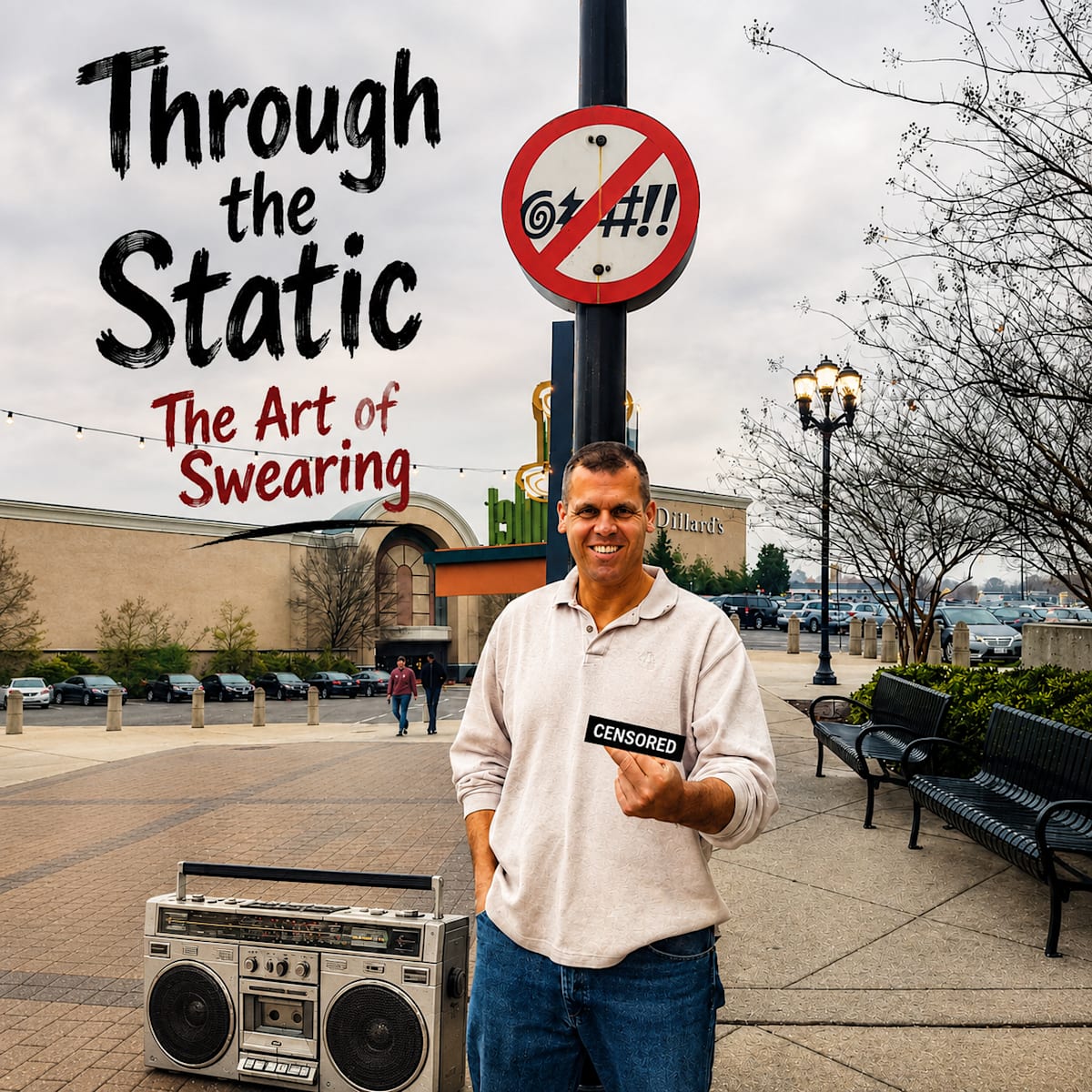
Through the Static – The Art of Swearing [Explicit]